Sunday Tech Corner with Alex
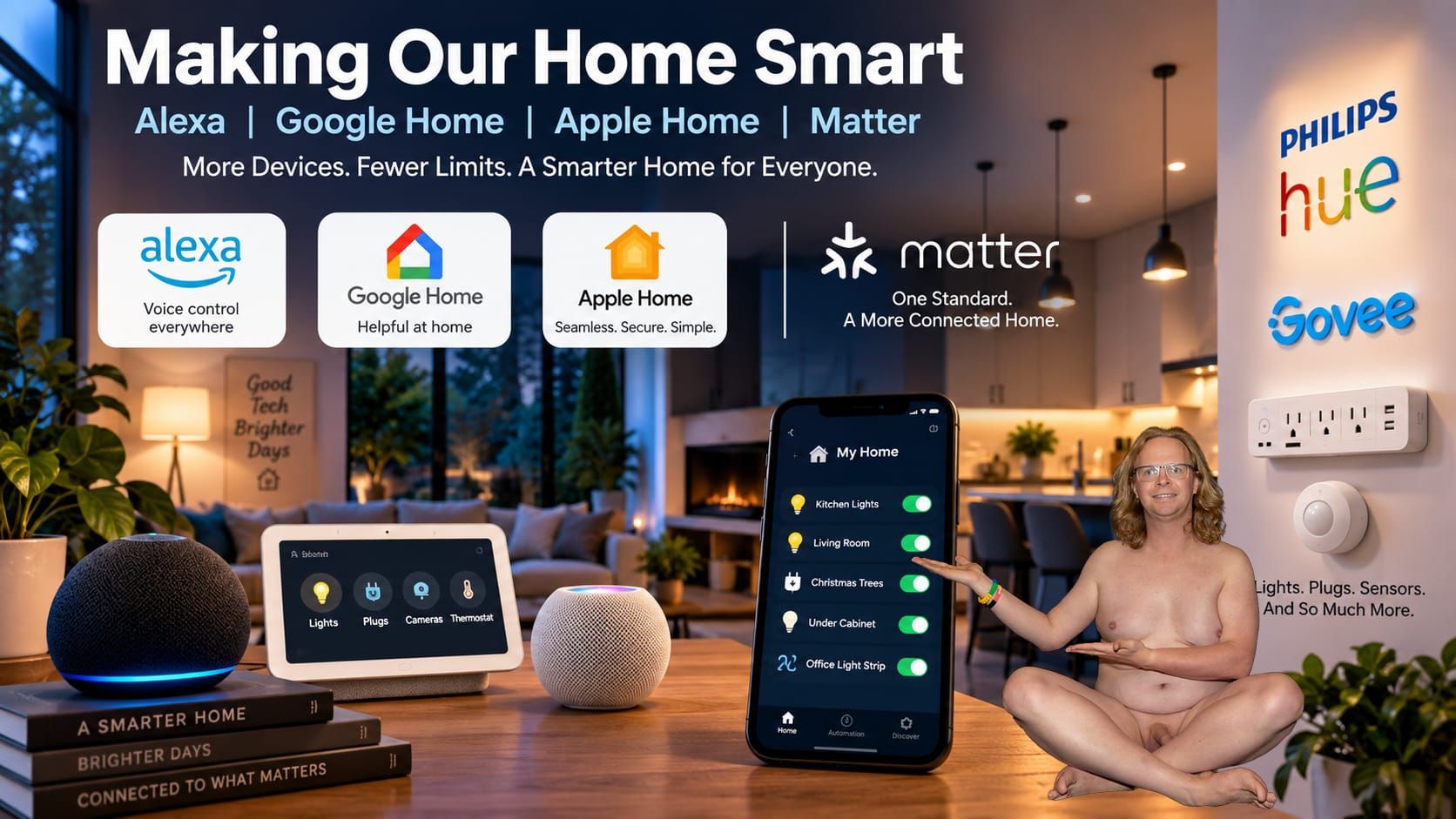
Since buying a home, we’ve gradually worked on making our house smarter. From lights and plugs to motion sensors and automated routines, smart-home technology has become part of our everyday life.
One of the most important things we look at before buying any new smart-home device is compatibility. Whenever possible, we want products that work with Amazon Alexa, Google Home, and Apple Home. In the past, finding a device that supported all three could be challenging, but Matter has made this considerably easier.
Alexa vs. Google Home vs. Apple Home
Although Alexa, Google Home, and Apple Home accomplish many of the same things, each platform has its own strengths.
Amazon Alexa is probably one of the most widely supported smart-home platforms. A huge number of lights, plugs, switches, cameras, thermostats, and other devices work with Alexa. It’s especially useful if you have Echo speakers throughout your home and like controlling things by voice.
Google Home provides similar functionality and works particularly well with Google and Nest products. Google Assistant/Gemini-enabled devices can be used to control compatible lights, plugs, thermostats, and other equipment by voice or through the Google Home app.
Apple Home is Apple's smart-home ecosystem and is particularly convenient if you already use an iPhone, iPad, Apple Watch, Apple TV, or HomePod. You can control devices through the Home app, Siri, Control Center, automations, and scenes. Apple also places a strong emphasis on privacy and keeping smart-home processing within your home whenever possible.
The problem used to be that you might find a great smart bulb that worked with Alexa and Google Home but didn't support Apple Home—or vice versa. That's where Matter comes in.
What Is Matter?
Matter is a smart-home interoperability standard supported by major technology companies, including Amazon, Apple, Google, Samsung, and many smart-home manufacturers.
Instead of manufacturers having to create completely separate versions of their products for each ecosystem, a Matter-compatible device can generally work across multiple supported smart-home platforms.
For us, this makes shopping much easier. When I'm looking at a new smart-home product, seeing the Matter logo is one of the first things I check for. It means there is a much better chance that the device will work with Alexa, Google Home, and Apple Home instead of locking us into a single ecosystem.
We Started With Philips Hue
When we first started buying smart-home devices, we went with Philips Hue lights. One thing to know about Hue is that they can be expensive, but overall, they work very well.
We also added smart plugs so we could automatically turn devices on and off, control them with our voices, or manage them through our smart-home apps.
Overall, our early smart-home setup probably worked correctly about 75% of the time. Unfortunately, the other 25% could be extremely frustrating. There's nothing quite like telling a smart assistant to turn off a light several times and eventually getting up and turning it off yourself!
One interesting feature Hue has introduced is MotionAware, which allows compatible Hue lights to detect motion without requiring a separate traditional motion sensor. With a supported setup and multiple compatible lights in a room, the system can detect movement and trigger your lights automatically.
Discovering Govee
Recently, I wanted to add more smart lighting and discovered Govee. So far, I've been very impressed, particularly with the price.
Many Govee products are considerably less expensive than comparable Hue products. I was able to install four recessed lights in our kitchen for around $80, while a comparable Hue setup would have cost me more than $200.
Setup was easy, and because the lights I purchased support Matter, I was able to integrate them with Alexa, Google Home, and Apple Home.
I also installed a Govee light strip in my office to improve the lighting, and I've really enjoyed it. It adds additional ambient lighting without requiring another lamp or fixture.
One difference from Hue's newer MotionAware capability is that my Govee bulbs don't provide that same built-in motion-detection experience. However, that's easy to solve by adding a separate compatible motion sensor, and inexpensive sensors can be found for around $12.
What's Next?
The next Govee product I'm considering is their permanent outdoor lighting. These are lights that can remain installed year-round instead of putting Christmas lights up and taking them down every holiday season. You can change the colors and effects for Christmas, Halloween, Pride, birthdays, or simply use them as outdoor accent lighting throughout the year.
I'd also like to install under-cabinet lighting in our kitchen. My goal would be to have the lights automatically turn on at night and provide a soft glow against the wall or backsplash instead of having to turn on the main kitchen lights.
Don't Forget Smart Power Strips
Another smart-home product I've found extremely useful is a smart power strip.
Instead of controlling only one device like a standard smart plug, a smart power strip can let you control several connected devices. Depending on the model, you may even be able to control individual outlets separately.
I use one for the Christmas trees in my office—which stay up year-round—and I love it. I can turn everything on or off together without crawling under a desk looking for switches.
Matter Is Making the Smart Home Better
The biggest improvement I've seen since we started building our smart home isn't necessarily a particular bulb or smart assistant—it's compatibility.
Alexa, Google Home, and Apple Home are still separate ecosystems, but Matter is helping bridge the gap between them. Instead of deciding which ecosystem you're going to be locked into before purchasing a device, you can increasingly choose the product you actually want and connect it to the smart-home platform you prefer.
If you're starting a smart home today, my biggest recommendation is simple: check for Matter compatibility before you buy. It can make expanding or changing your smart-home setup much easier in the future.