Sunday Tech Corner with Alex
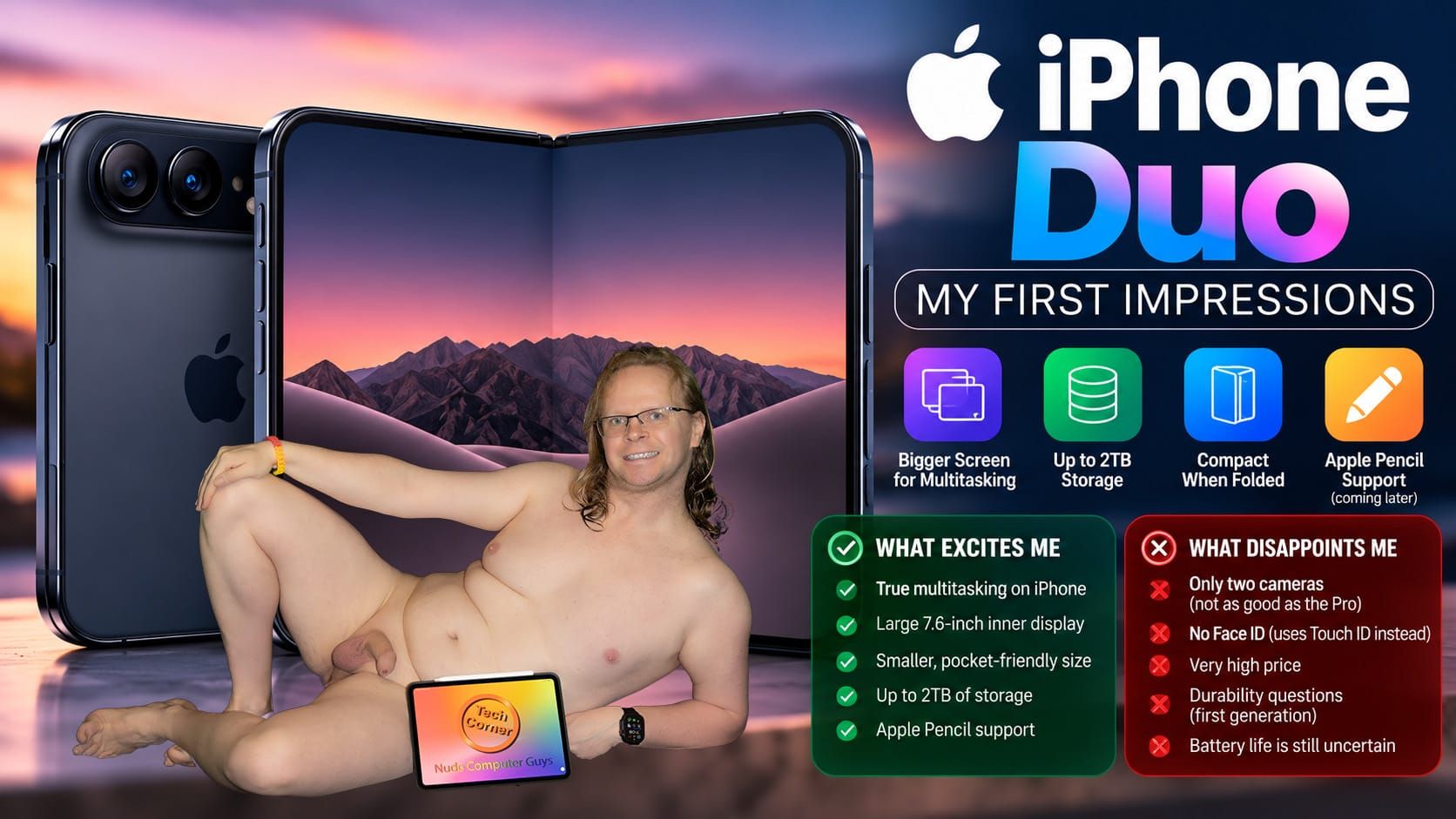
Why I Ordered Apple’s New iPhone Duo: What Excites Me and What Disappoints Me
Well, I did it! I got up at 5:00 AM on Friday, October 16, to order Apple's brand-new iPhone Duo, the company's first foldable iPhone. I've been looking forward to Apple entering the foldable smartphone market, and now that it's finally happening, I'm excited to see how Apple's approach compares to what Google and Samsung have already been offering.
I placed my order right when the Apple Store opened for preorders. I went with the 2TB model in blue, but despite ordering immediately, my estimated delivery date is currently November 2–9. That's a little disappointing, especially since the official launch date is October 23. I'm hoping Apple moves my delivery date forward as it processes the initial orders.
So, why did I decide to purchase the iPhone Duo? And is it really worth the premium price?
There are several reasons I'm excited about this device, but there are also a few compromises I'm not particularly happy about.
Why I'm Excited About the iPhone Duo
1. Finally, a Foldable iPhone!
For those who don't know, I actually use two smartphones: an iPhone 17 Pro and a Google Pixel 10 Pro Fold.
Yes, I know. Two phones might sound a little excessive, but as someone who works with technology, I enjoy experiencing what both Apple and Google have to offer.
One of my favorite features of the Pixel Fold is its large folding display. Having the ability to open my phone and essentially turn it into a small tablet has been incredibly useful.
Whether I'm reading articles, responding to emails, browsing websites, or watching videos, having that additional screen space makes a noticeable difference.
Now Apple is bringing that experience to the iPhone, and I'm particularly interested in seeing how well it integrates with the Apple ecosystem.
The iPhone Duo features two displays:
- 5.4-inch outer display: A more compact screen for everyday tasks when the phone is folded.
- 7.6-inch inner display: A much larger screen for multitasking, reading, entertainment, and productivity.
Both displays support ProMotion technology with refresh rates up to 120Hz, which should make scrolling and animations feel smooth.
The inner display also includes a special nano-texture finish designed to reduce reflections and make the crease less noticeable.
I'm especially curious to see how well Apple has managed the crease in the folding display, since that's something foldable phone manufacturers have been working to improve for years. Apple
2. Multitasking Is One of My Biggest Reasons for Upgrading
One of the biggest reasons I enjoy my Pixel Fold is the ability to run multiple apps at the same time.
For example, I can have a website open on one side of the screen while responding to an email on the other. Or I can watch a YouTube video while looking something up without constantly switching between applications.
Traditional iPhones have never offered this type of side-by-side multitasking.
That's why I'm particularly excited about the iPhone Duo.
With iOS 27, Apple has introduced Split View multitasking, allowing compatible apps to run side by side on the larger folding display.
This could be particularly useful for my work in IT, where I often need to reference information while performing another task.
I can see myself using this when troubleshooting technology, researching products, working with documents, or communicating with clients.
Of course, one question I still have is how Apple's implementation will compare with Google's.
Android foldables have had several years to refine their multitasking capabilities. Apple is entering this market later, so I'll be interested to see whether iOS 27 provides the same flexibility, especially when working with third-party applications.
I'm also curious whether app developers will fully embrace the larger display or whether some applications will initially feel like stretched-out versions of their traditional iPhone counterparts. Apple
3. A Bigger Screen Without Carrying a Large Phone
Another feature I'm looking forward to is the smaller form factor when the iPhone Duo is folded.
I love having a large display, but I don't necessarily want to carry around an oversized phone all day.
The Duo offers an interesting compromise.
When folded, it's compact enough to fit comfortably in a pocket. But when I want additional screen space, I can simply unfold it.
I think this could be especially convenient when traveling.
Instead of constantly pulling out my iPad to watch something, review documents, or browse the web, I'll have a much larger display available directly on my phone.
However, there's a downside worth mentioning.
Although the Duo is compact when folded, it's also thicker than a traditional iPhone. It weighs approximately 254 grams and measures 11.3 mm thick when closed.
So while it might take up less space vertically in my pocket, it will still be a relatively thick and heavy device.
I'm curious to see how comfortable it feels to carry throughout the day.
4. The 2TB Storage Option Is a Huge Plus
Another feature I'm extremely excited about is Apple's decision to offer the iPhone Duo with up to 2TB of internal storage.
I ordered the 2TB version because I tend to keep a lot of content on my devices.
One thing I especially enjoy doing is downloading movies and television shows so I can watch them when I don't have an internet connection.
This is particularly convenient when flying, traveling through areas with limited cellular service, or spending time somewhere without reliable Wi-Fi.
With 2TB of storage, I should have plenty of room for downloaded entertainment, photos, videos, applications, and other files.
I also have a substantial collection of movies and television shows purchased through Apple, so having the ability to download more of that content directly to my phone is a major advantage.
The larger 7.6-inch display should make watching those shows much more enjoyable than on a traditional iPhone.
Of course, downloads from streaming services still depend on each service's restrictions, and some content may require periodic online verification.
Still, combining a tablet-sized screen with 2TB of storage makes this device particularly appealing to me.
5. Apple Pencil Support
One feature I wasn't necessarily expecting to be excited about is Apple Pencil support.
Apple has confirmed that the iPhone Duo will support the Apple Pencil (USB-C) later this year.
Although I don't expect to replace my iPad, I can see this becoming useful for taking quick notes, marking up documents, and making annotations.
As someone who works in IT, being able to quickly sketch out a network diagram or annotate a screenshot directly on my phone could be quite convenient.
I'm also interested in seeing how useful this becomes for photography.
While the iPhone Duo won't replace a dedicated photo-editing workstation, having a larger screen and stylus support could make quick photo adjustments and annotations more practical.
The downside is that Apple Pencil functionality won't be available immediately at launch, so this is one feature I'll have to wait to try. Apple
What Disappoints Me About the iPhone Duo
As excited as I am about Apple's first foldable iPhone, there are definitely some compromises.
And considering how expensive this phone is, I think it's important to talk about them.
1. The Camera System Is a Step Back From the Pro Models
This is probably my biggest disappointment.
As someone who enjoys photography, the camera system is one of the most important features I consider when purchasing a smartphone.
I've been very happy with the cameras on my iPhone 17 Pro, particularly the flexibility offered by its three rear cameras.
Unfortunately, the iPhone Duo doesn't include the same three-camera system found on the iPhone 17 Pro or the newer iPhone 18 Pro.
Instead, Apple has included two rear cameras:
- 48MP Fusion Main camera
- 48MP Fusion Ultra Wide camera
The main camera also provides 2x optical-quality zoom through its sensor.
While these are certainly capable cameras, the lack of a dedicated telephoto lens is disappointing.
With the iPhone 18 Pro, Apple offers a much more versatile photography system, including a dedicated telephoto camera with substantially greater zoom capabilities.
The iPhone 18 Pro also includes a new variable-aperture main camera, which provides additional flexibility when photographing subjects in different lighting conditions.
For someone like me who enjoys taking photographs, particularly when traveling, losing that flexibility is a meaningful compromise.
I understand that Apple has limited space to work with in a foldable design, and fitting additional camera hardware into such a thin device presents engineering challenges.
However, when you're paying this much for a smartphone, it's reasonable to expect a camera system comparable to Apple's best iPhones.
There are some interesting benefits to the Duo's folding design, though.
For example, you can use the rear cameras to take selfies while seeing yourself on the outer screen. Apple also introduced Duo Preview, which allows the person being photographed to see how the shot is framed.
The phone can even be partially folded and positioned on a surface for hands-free photography or video recording.
These are useful features, but they don't completely make up for losing the dedicated telephoto camera. Apple
2. Goodbye Face ID, Hello Touch ID
Another change I'm not particularly excited about is the removal of Face ID.
I've become so accustomed to unlocking my iPhone using facial recognition that I rarely think about it anymore.
I simply pick up my phone, look at the screen, and it's unlocked.
With the iPhone Duo, Apple has replaced Face ID with Touch ID integrated into the side button.
That means I'll be returning to fingerprint authentication.
Touch ID certainly isn't a bad technology. In fact, there are situations where fingerprint recognition can be more convenient than facial recognition.
However, I personally prefer Face ID, and it's disappointing to see Apple remove it from such an expensive device.
I suspect this decision was influenced by the physical limitations of the folding design, since Apple has to accommodate multiple displays, cameras, and other components.
One positive feature is that Apple has confirmed you'll also be able to unlock the iPhone Duo using a compatible Apple Watch.
Since I already use an Apple Watch, I'm interested in seeing how convenient that option will be in everyday situations.
Still, I expect there will be an adjustment period as I get used to Touch ID again.
3. The Price Is Extremely High
There's no getting around this one.
The iPhone Duo starts at $1,999, making it one of Apple's most expensive smartphones.
And that's only for the base model with 256GB of storage!
Since I ordered the 2TB version, the price is considerably higher.
For that amount of money, I could purchase an excellent iPhone Pro model and still have money left over for another device.
I understand that foldable technology is expensive to manufacture, particularly when you're dealing with flexible OLED displays, specialized hinges, and complicated internal engineering.
However, I think the price will be a significant barrier for many customers.
It's especially difficult to justify when you consider that the Duo makes compromises in areas such as camera hardware and biometric authentication.
In many ways, you're paying a premium for the folding display rather than getting every feature Apple offers.
For me, the value will ultimately depend on how much I use the larger display and multitasking features.
4. Durability and Long-Term Reliability
Another concern I have involves durability.
Traditional smartphones are relatively straightforward devices compared with foldables.
Once you introduce a flexible display and a mechanical hinge, you're adding components that can potentially wear over time.
Apple says the iPhone Duo uses a precision-engineered hinge, durable materials, and multiple protective layers designed to withstand repeated folding.
The device also features an IP68 water- and dust-resistance rating.
Those specifications are encouraging.
However, this is Apple's first generation of foldable iPhone, and we don't yet know how well these devices will hold up after several years of regular use.
I'm particularly interested in seeing how the inner display ages, whether the crease becomes more noticeable, and how resistant the screen is to scratches.
Foldable displays generally require more care than traditional glass smartphone screens.
Another concern is the potential cost of repairs.
Replacing a folding display could be considerably more expensive than replacing the display on a traditional iPhone.
Because of that, AppleCare+ may be especially worth considering for this device.
5. Will the Battery Last All Day?
Battery life is another area I'll be watching closely.
A folding phone has to power a much larger screen than a traditional smartphone, and that can place additional demands on the battery.
Apple has equipped the Duo with a dual-battery system and the A20 Pro processor, which is designed to deliver efficient performance.
The phone also features a vapor-chamber cooling system to help manage heat.
However, specifications and marketing claims don't always tell the full story.
I want to see how well the battery performs when I'm actively multitasking, watching videos, using cellular data, and taking photographs.
It will also be interesting to compare battery life when using the smaller outer display versus the larger inner display.
Since I already own a Pixel Fold, I'll have an opportunity to compare the two devices under similar conditions.
I'm hoping the Duo delivers excellent battery life, but I'll reserve judgment until I've spent some time using it.
6. First-Generation Technology Comes With Risks
Whenever Apple introduces an entirely new product category, there are usually lessons learned during the first generation.
The iPhone Duo is no exception.
While Apple has had plenty of time to study competing foldable smartphones, this is still the company's first attempt at bringing that technology to the iPhone.
There could be unexpected software bugs, compatibility issues with certain applications, or design limitations that only become apparent after people begin using the phone regularly.
I'm particularly interested in seeing how developers adapt their applications to the larger display.
Some apps may work beautifully from day one, while others may need updates to fully support the folding form factor.
I'm also curious how well the phone handles transitions between the outer and inner displays, especially when switching between multiple running applications.
These are all things that will become clearer with real-world use.
Why I Still Decided to Buy It
Despite these compromises, I'm genuinely excited about the iPhone Duo.
For me, this purchase isn't necessarily about getting the best camera system or the absolute longest battery life.
It's about having access to a completely different iPhone experience.
I've enjoyed using my Google Pixel Fold, and one of the things I've wanted for a long time is the ability to bring that same flexibility to Apple's ecosystem.
Having a larger screen for multitasking, watching movies, browsing websites, and working with applications could fundamentally change how I use my iPhone.
I'm especially interested in seeing how Apple approaches foldable software compared with Google.
Will multitasking be as intuitive? Will applications take full advantage of the larger screen? Will the folding design feel comfortable enough to use every day?
And perhaps most importantly, will the experience be good enough that I prefer using the Duo over my traditional iPhone?
Those are questions I won't be able to answer until I've spent some time with the device.
I also plan to compare the iPhone Duo directly with my Google Pixel Fold, looking at everything from screen quality and multitasking to photography, battery life, and overall usability.
Final Thoughts: Excited, but With Realistic Expectations
I think the iPhone Duo represents one of the most interesting changes to the iPhone in years.
For a long time, smartphone upgrades have primarily focused on faster processors, improved cameras, brighter displays, and better battery life.
Those improvements are certainly welcome, but they don't always fundamentally change how we interact with our devices.
The iPhone Duo has the potential to do exactly that.
The ability to carry a compact smartphone that unfolds into a much larger productivity and entertainment device is something I've already come to appreciate with my Pixel Fold.
Now I'm excited to see what Apple brings to the experience.
At the same time, I'm disappointed that Apple couldn't include the same advanced camera system found on its Pro models, and I'll definitely miss Face ID.
The high price and questions about long-term durability are also legitimate concerns.
Ultimately, I think the iPhone Duo is a device that prioritizes versatility and a new way of using an iPhone over having the very best of every individual feature.
Whether those trade-offs are worthwhile will depend on how much you value the folding display.
For me, the opportunity to combine the flexibility of a foldable smartphone with the Apple ecosystem was enough to convince me to place an order.
Now I'm just hoping Apple moves up my delivery date so I can get my hands on it sooner!
And once it arrives, I'm looking forward to putting it through its paces and finding out whether Apple's first foldable iPhone can truly compete with my Google Pixel Fold.
What do you think? Would you consider purchasing Apple's first foldable iPhone, or do you think the compromises and high price make it better to wait for the second generation?