
The Glory Hole Is Older Than America

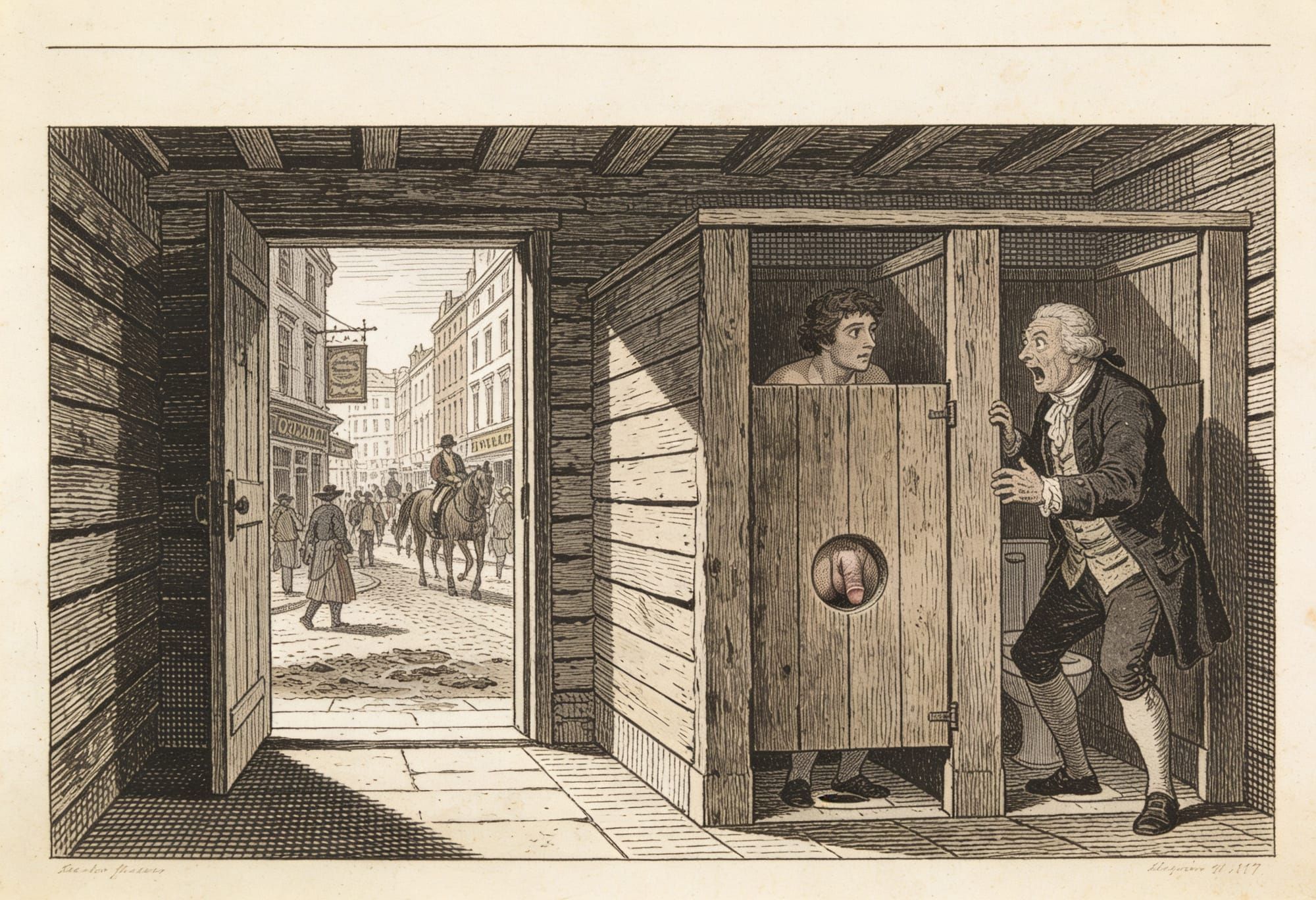
Long before gay bathhouses, adult bookstores, porn theaters, truck stops, and certain particularly adventurous men's rooms, some horny fellow in London apparently looked at the wooden wall separating two toilet stalls and had an idea.
We know this because, wonderfully, somebody ended up talking about it in court.
The year was 1707. George Washington wouldn't be born for another 25 years. The United States wasn't even a twinkle in anyone's eye. London was crowded, dirty, busy, and filled with public conveniences known by such charming names as bog-houses and vaults. And somewhere near London's Temple district, a man named Mr. Guillam needed to relieve himself.
Guillam was a tallow chandler, which meant he made or sold candles. He had been conducting business in Southwark and returned across the Thames, landing at Temple Stairs. Nature called, so he headed for the Temple Bog-House.
What happened next survives because Guillam later described the encounter during a criminal proceeding.
According to the published account, he had barely settled into the privy when "a Boy in the adjoyning Vault put his Privy-member through a Hole."
There it is.
A glory hole.
In 1707.
Of course, nobody involved called it a glory hole. The sexual meaning of that term arrived much later. But the basic arrangement is unmistakable. Two neighboring compartments. A wooden partition between them. A strategically placed hole. And one gentleman offering the gentleman next door a rather unexpected alternative to simply using the toilet.
Guillam, according to his testimony, was having none of it. He said he was so surprised by the sudden appearance of the aforementioned "Privy-member" that he immediately left.
Unfortunately for him, the story didn't end when he pulled up his breeches.
The young man followed Guillam out and began shouting after him, accusing Guillam of attempting to "bugger" him. Another man, Thomas Vaughan, intercepted Guillam and demanded to know where he lived. Soon Vaughan, Thomas Davis, and two other men were threatening him with public accusations of sodomy unless he paid them.
And in 1707 England, this was no small threat.
Sex between men wasn't merely scandalous. Sodomy was a capital crime. An accusation alone threatened a man's reputation, livelihood, family, and potentially his life.
Guillam had a wife, children, a business, and a reputation. The men knew exactly where to apply pressure.
Eventually, he handed over 20 shillings and signed a note promising another 20.
He wasn't their only target.
Vaughan and Davis were ultimately prosecuted for a larger extortion operation in which accusations of sodomy were allegedly used to frighten men into paying them. Their scheme eventually collapsed, and both men were convicted. Their punishment included the pillory, whipping from Temple Bar to Charing Cross, fines, and imprisonment until those fines were paid.
And because the whole ugly affair ended up in the historical record, so did one wonderfully peculiar detail about a hole in the wall of a London toilet.
So Was This the First Glory Hole?
Almost surely not.
It is better described as one of the earliest known written records of the practice. Nobody invented the hole in 1707 simply because this is when someone happened to write about one.
That's an important distinction.
Anonymous sex rarely leaves a tidy historical archive. Nobody was keeping minutes. The people participating often had strong reasons to keep quiet, especially when sex between men carried enormous legal and social consequences.
The physical concept was also ridiculously simple. Put two private compartments beside each other. Build a wooden wall between them. Add a hole.
Eventually, somebody was going to get creative.
What makes the Guillam story extraordinary isn't necessarily what happened. It's the fact that what happened survived.
Paris Gets Busy
By the 19th century, the historical trail becomes easier to follow.
Public urinals had become meeting places for men seeking sexual encounters in Paris. Authorities knew what was happening and repeatedly tried to stop it.
Reports from the period describe holes appearing in partitions between compartments. Officials filled them with plaster and cement.
Men reopened them.
At some facilities, wooden partitions were replaced with iron.
Those reportedly ended up pierced as well.
It's difficult not to admire the persistence.
The architecture itself offered something gay and bisexual men desperately needed at the time: separation from public view. Two men didn't need to walk into a room together. They didn't need to exchange names. They didn't even necessarily need to see each other's faces.
The wall provided both the obstacle and the solution.
When Did We Start Calling It a Glory Hole?
That's where the history takes another turn.
"Glory hole" existed in English long before anyone used the phrase sexually. Earlier definitions referred to things such as storage spaces, small rooms, cupboards, or miscellaneous spaces filled with clutter.
The sexual meaning appears much later.
One early documented example comes from American homosexual slang in 1949. By 1970, linguist Julia P. Stanley included "glory hole" in an academic study of American homosexual slang and described the familiar opening between public toilet stalls used for sexual encounters.
By then, the hole finally had its name.
And soon it would get an upgrade.
From Public Toilets to Gay Institutions
During the sexual liberation of the 1960s and 1970s, something changed.
The glory hole didn't disappear from public bathrooms. Instead, businesses started building them intentionally.
Adult bookstores, porn theaters, sex clubs, bathhouses, and private establishments incorporated partitions and openings into their spaces. What once involved somebody secretly attacking a bathroom wall with a tool became part of the architecture.
For gay men, especially those living through decades when being openly gay carried enormous personal consequences, the appeal wasn't difficult to understand.
A glory hole offered anonymity.
No introductions. No questions about jobs or families. No need to explain whether you were gay, bisexual, married, closeted, curious, or something you hadn't figured out yet.
There was a wall between you.
For some men, the wall wasn't an inconvenience. It was the entire point.
Then Came AIDS
The AIDS epidemic transformed gay sexual culture during the 1980s.
Bathhouses and sex clubs came under intense public-health and political scrutiny. Some closed. Others changed their rules and physical layouts. Gay men themselves radically changed sexual behavior as the community confronted a terrifying new disease nobody initially understood.
Yet the glory hole survived.
It remained in clubs, adult theaters, saunas, bookstores, private play spaces, and eventually the internet age. Today, the term has escaped gay slang almost completely. Straight people know what it means. It's referenced in television and comedy. Purpose-built versions exist in sex venues around the world.
Something once hidden inside public toilets became one of the most recognizable pieces of sexual architecture on Earth.
Which brings us back to Mr. Guillam.
More than 300 years ago, the poor man walked into a London bog-house because he needed to pee. A penis unexpectedly appeared through the wall, he fled, and a criminal extortion scheme eventually put the entire episode into the historical record.
Guillam surely had no idea anyone would still be talking about his bathroom visit three centuries later.
But history has a funny way of remembering the details nobody thought were important.
Kings have been forgotten. Buildings have disappeared. Entire neighborhoods have changed beyond recognition.
But somewhere along the way, somebody put a dick through a hole in a bathroom wall.
And somebody wrote it down.