
The Newport Navy Sex Scandal (1919–1921)

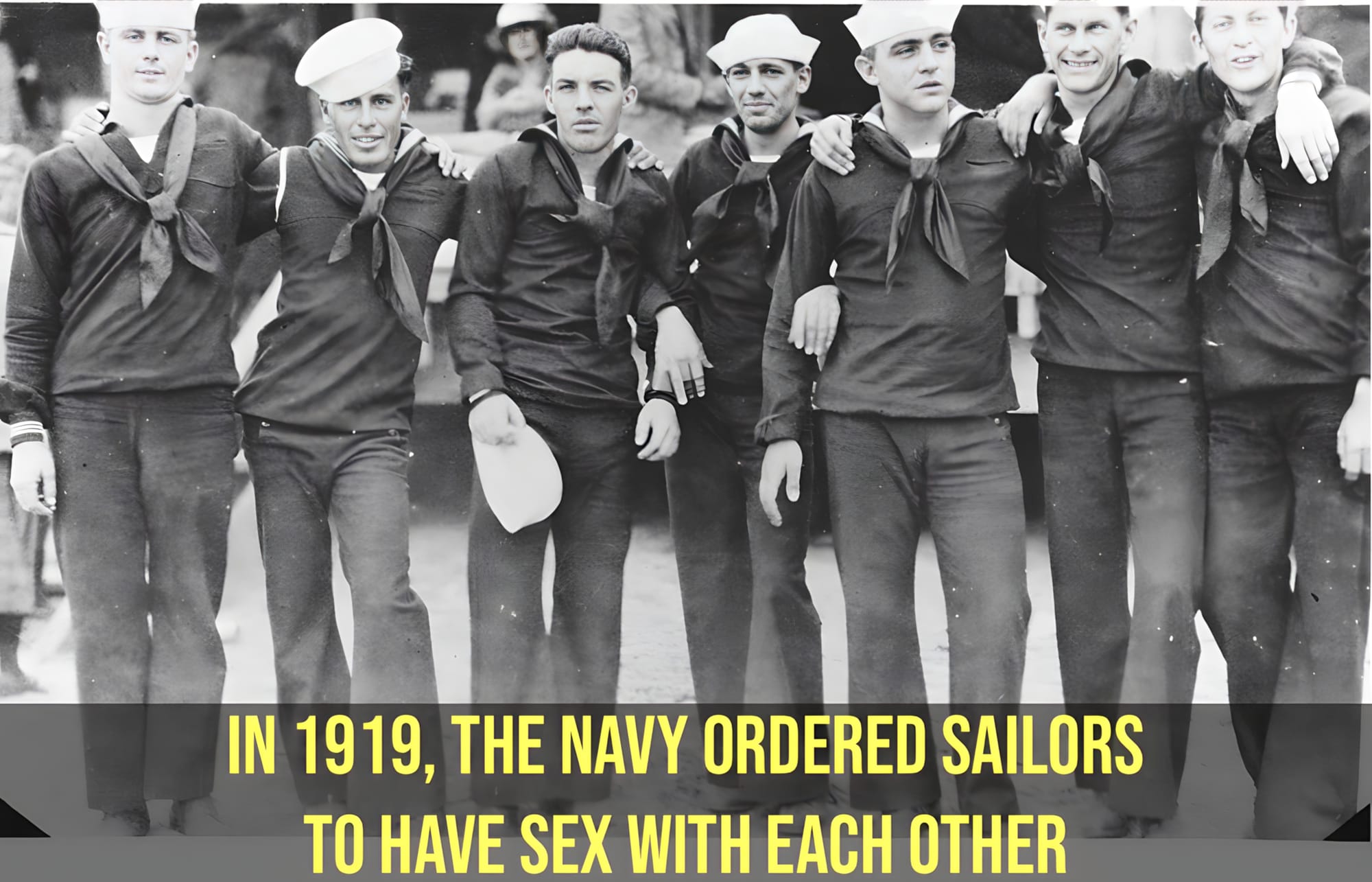
When the Navy Accidentally Documented America’s Hidden Gay World
History has a funny habit of doing the opposite of what people intend.
In 1919, the United States Navy set out to eliminate homosexuality from its ranks. Officers believed that a handful of sailors stationed in Newport, Rhode Island were secretly having sex with other men. To the Navy, this was not just immoral. It was a threat to discipline and order. Something had to be done.
So they launched an investigation.
What followed became one of the strangest scandals in early twentieth-century America. Instead of quietly rooting out a few offenders, the Navy stumbled into an entire social world it never knew existed. Even more ironic, the investigation meant to destroy that world ended up preserving one of the earliest detailed records of gay life in the United States.
The episode became known as the Newport sex scandal.
The Navy Goes Hunting
The investigation began at the Naval Training Station in Newport, a busy installation where young sailors trained before being sent out across the fleet. Rumors had begun circulating among officers that some sailors were engaging in “immoral practices.” In the language of the time, that meant homosexual activity.
Naval intelligence officers decided to conduct a sting operation.
Young enlisted sailors were recruited and ordered to go undercover. Their assignment was simple in theory and astonishing in practice. They were told to infiltrate the suspected circles of gay sailors, gain their trust, and gather evidence.
To do that, they were instructed to flirt.
They were told to attend social gatherings.
And in some cases, they were ordered to go further and have sex with the men they were investigating.
The goal was to identify as many participants as possible. Investigators expected they might uncover a small number of offenders and quietly clean house.
That is not what happened.
A Hidden Social Network
As the undercover sailors moved through Newport’s boarding houses, cafés, and rented rooms, they began reporting something unexpected.
The men they encountered were not random individuals engaging in isolated encounters. They appeared to belong to a recognizable community.
Investigators documented gatherings where men met to drink, socialize, and flirt. Boarding houses where rooms were quietly rented for private meetings. Certain places around town where sailors knew they might find like-minded company.
The reports even described a shared vocabulary.
Some men were referred to as “fairies,” a term commonly used at the time for effeminate gay men. These individuals often adopted mannerisms or styles of dress that stood out from the typical masculine culture of the Navy.
Other men were described as their counterparts. They courted the “fairies,” bought them drinks, and played a more traditionally masculine role in the relationships.
To the investigators, it was shocking. They had expected to uncover a few immoral acts. Instead they were staring at what looked like a fully formed subculture with its own social codes and relationships.
One report noted that certain sailors were well known within this world and could introduce newcomers to others. Another described how men signaled their interests through subtle gestures or coded language.
In short, the Navy had discovered that queer men had already built ways to find each other and form community long before the modern gay rights movement ever existed.
A Sting That Went Too Far
The investigation grew larger and more aggressive as it continued.
Undercover sailors compiled lists of names. Suspected men were questioned and pressured to reveal others. The operation expanded well beyond the original handful of suspects.
By the end, dozens of sailors and civilians had been accused.
But the most controversial part of the investigation was the method itself.
The Navy had not simply observed suspected behavior. It had ordered enlisted men to actively participate in it. The undercover sailors were expected to initiate encounters and engage in sex acts so that investigators could claim proof.
When details of the operation began to circulate, the public reaction was immediate.
Many people were less concerned about the existence of gay sailors than they were about what the Navy had forced its own men to do.
Congress Steps In
The scandal eventually reached Washington.
In 1921, a United States Senate investigation was launched to examine the Navy’s tactics. Senators reviewed testimony from the investigators, the undercover sailors, and some of the accused men.
The hearings were heated.
Several lawmakers were openly appalled by the investigative strategy. One senator described the operation as disgusting. Another argued that the Navy had essentially manufactured the very behavior it claimed to be policing.
The central question became whether the Navy had crossed a moral and legal line by ordering young enlisted men to seduce others in the course of an investigation.
The Senate ultimately criticized the Navy’s methods and reprimanded several officials involved in the case. The scandal damaged reputations and brought uncomfortable national attention to a subject that most Americans rarely discussed in public.
An Accidental Archive
The strangest twist of the Newport scandal is what it left behind.
The transcripts of the investigation, along with the reports written by naval officers and undercover sailors, preserved an extraordinary amount of detail about queer life in the early twentieth century.
Historians studying sexuality now view those documents as a rare window into a world that was usually hidden.
They reveal men who socialized together, flirted openly in certain settings, and formed relationships. They show the existence of coded language and informal networks that allowed gay men to find one another in an era when homosexuality was criminalized almost everywhere.
Perhaps most importantly, they demonstrate that queer identity and community did not suddenly appear in the twentieth century.
It had already been there.
Quietly thriving beneath the surface.
The Irony of Newport
The Navy believed it was exposing something rare and deviant.
What it actually revealed was something much more complicated. Even in 1919, long before Pride marches, rainbow flags, or modern activism, men had already built spaces where they could recognize each other and connect.
The investigation meant to stamp out that world ended up documenting it in remarkable detail.
History does that sometimes.
Authorities try to erase something.
And instead, they accidentally write it down for the future to find.
Sources: U.S. Senate Committee on Naval Affairs, Investigation of Immoral Conditions at the Naval Training Station, Newport, Rhode Island (1921); John Loughery, The Other Side of Silence: Men’s Lives and Gay Identities (1998); George Chauncey, Gay New York: Gender, Urban Culture, and the Making of the Gay Male World, 1890–1940 (1994); contemporary coverage in The New York Times and other U.S. newspapers during the 1921 Senate hearings.