When Your Nervous System Becomes Political
by JP
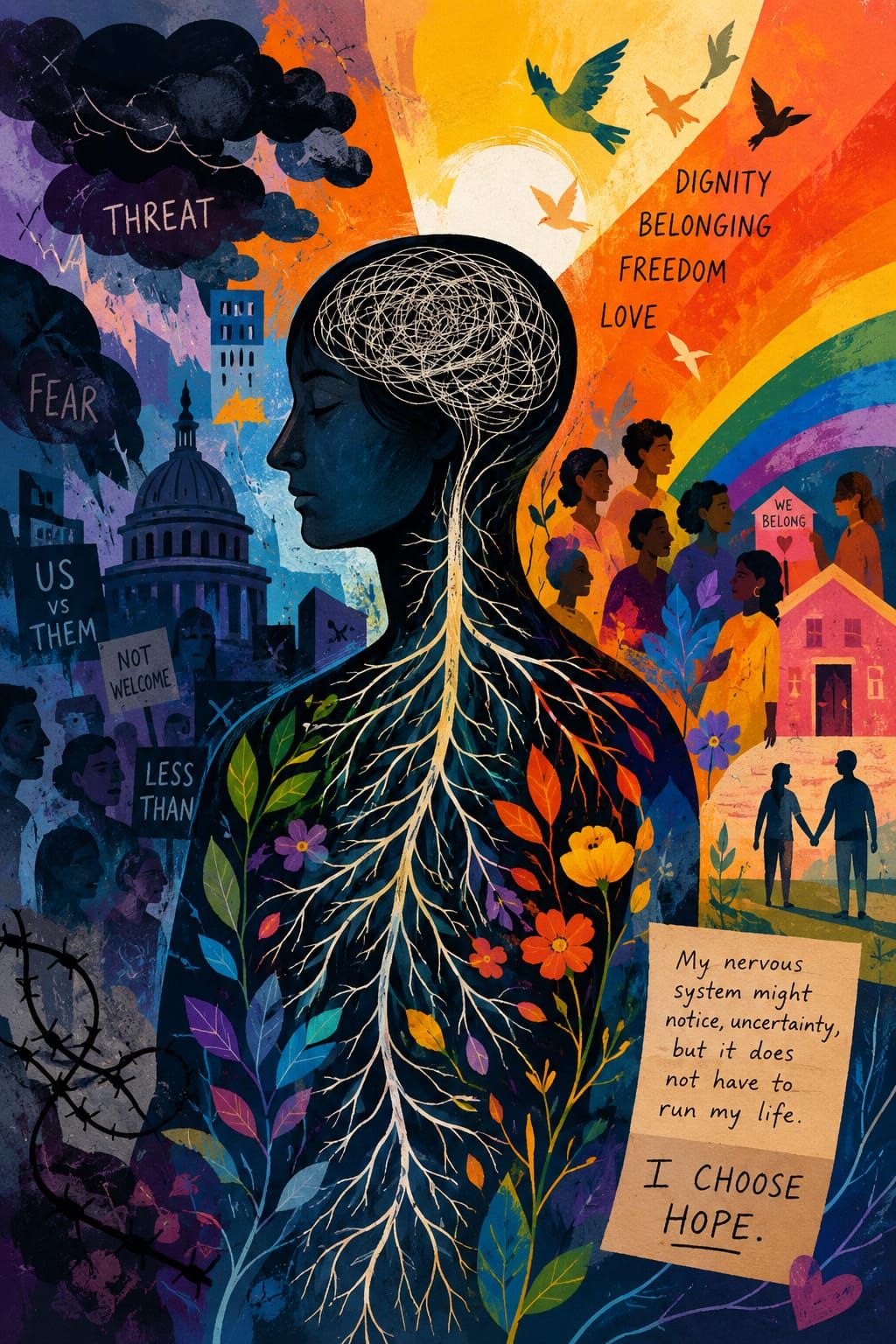
When political uncertainty becomes the norm, people are more anxious, emotionally drained, and unable to focus. These are not isolated reactions. Political instability doesn't just stay in legislatures or courts; it becomes integrated into everyday life and shapes the decisions people make. As public debates increasingly question the worth and dignity of marginalized groups, those communities, along with the people who love and support them, often feel less secure and less certain that they truly belong. The consequences are no longer limited to politics. They shape how safe we feel, how we relate to other people, and whether we can imagine the future with confidence.
As a therapist, I see this in my clients and sometimes in myself. Chronic stress affects the nervous system. It keeps our minds focused on possible dangers rather than future possibilities. Energy that could be used to build relationships, pursue meaningful work, create art, raise a family, serve others, or simply enjoy life is being diverted into preparing for danger. When large numbers of people live in this constant state of vigilance, entire communities spend more time coping than growing. Good mental health is about more than the absence of depression or anxiety. It also depends on feeling safe enough to imagine a future, make plans, and believe those plans are worth pursuing.
When your sense of safety diminishes, it becomes difficult to prioritize growth. Most of your energy goes into protecting what you already have. Prolonged uncertainty trains your mind to keep scanning for future threats. It is not irrational; it is your brain’s way of trying to keep you safe. History shows that if governments view minorities as problems to solve instead of citizens to protect, uncertainty becomes more than anxiety. It becomes an ever-present source of stress that the nervous system never fully recovers from. One person’s prejudice can wound, but a government can rewrite your rights, decide which families matter, shape what children learn about you, and decide if you are treated as an equal or just tolerated.
For a long while, I thought uncertainty was something only earlier generations of gay men had to worry about. I believed we had reached a point from which we would not go back. Marriage equality was the law, workplace protections had increased, more people came out each year, and television, film, and public life reflected our lives more openly. I never thought prejudice had gone away, but I thought that things were moving in a kinder direction. Recently, some legal protections have diminished, and public debate has increasingly challenged rights that once seemed settled. My worry is not about one election, politician, or court decision.
The erosion of minority rights often begins not with major political shifts, but with gradual changes in how marginalized groups are perceived within democratic societies. Democracies can deal with disagreements. What scares me most is that more and more people regard gay people as a threat to culture, not just as citizens. For example, in the early 2000s, increased rhetoric about "protecting traditional marriage" contributed to ballot initiatives against same-sex marriage in multiple U.S. states, gradually shifting public perception and making policy reversals possible. When people are no longer seen as neighbors but as symbols, empathy starts to evaporate.
Before a society restricts a minority's rights, it often changes how that minority is perceived, as illustrated by political leaders in the United Kingdom during the 1980s, who framed the introduction of Section 28 by suggesting that promoting LGBTQ+ identities would endanger children. Disagreement is part of a healthy democracy. What democracies cannot survive is when disagreement turns into dehumanization. Rapid shifts in society, the economy, or culture create uncertainty, and blame is inevitable. It is easier to unite people against an enemy than to make it difficult for them to accept complexity. Throughout history, such as during the internment of Japanese Americans in World War II or the scapegoating of Jewish communities in various European countries, minorities have often been blamed, not because they were troublemakers, but because they were easy targets. Words matter because governments do not have to go to war against a minority to change how that minority is perceived.
They can do this by changing the language people use to decide who belongs and who does not. Studies in social psychology have found that a change in official or public language can shape attitudes over time. Describing LGBTQ+ people as a threat to "family values" has been associated with greater support for restrictive government policies and lower levels of public acceptance. Project 2025 recommends promoting a traditional, biblical view of the family and overturning many federal policies that recognize LGBTQ+ people. No matter one's political perspective, uncertainty can make people postpone major life decisions. They postpone marriage, reconsider starting a family, consider moving elsewhere, or wonder whether it is wise to build a future in a place where they feel less secure. Although those decisions may appear political on the surface, they are rooted in deeply personal questions about safety, belonging, and the kind of future someone believes is still possible.
Living with uncertainty does not mean pretending everything is okay. Trusting fear to organize your life comes with its own costs. The task is not denial but learning to distinguish between realistic awareness and constant vigilance. I often ask clients: Are you reacting to what is happening now, or to what you fear might happen? Anxiety lives in the future. It rehearses losses that have never happened and prepares us for conversations that may never come. This instinct evolved to keep you safe, but when it is always on, it wears you down.
Protect your nervous system as intentionally as you would protect your physical health. Stay informed, but limit how much news you absorb. Engage with people who remind you that you are more than a political label. Keep investing in friendship, creativity, travel, and work that matters to you. The more fear takes over, the smaller life can be. Purpose reminds you that there is still a life worth living. Do not put off living while waiting for certainty. Very few generations have known perfect stability. If you wait for the world to feel safe before you feel joy, you might wait forever. Healing does not mean pretending threats are not real. It means refusing to let them define who you are before they shape the life you build. Governments can change policies, but fear often persuades us to surrender possibilities long before anyone else takes them away. Protecting your inner freedom is part of resilience. It requires refusing to let fear dictate your life before circumstances do.
I don’t want younger gay men to bear the same psychological burden as previous generations did: having to calculate their safety before they can imagine their future. I hope they inherit a future where, even if there is still disagreement, they do not have to plan their lives around the fear that their humanity could be questioned again.
History leaves psychological traces. Communities remember what happened when minorities became easy targets, and those memories shape how people respond to uncertainty. This does not mean fear should rule us. It means history should inform us, not constrain us. For years, I assumed the only duty was to live truthfully. Now I see it also means staying alert. Democracies do not disappear overnight. They erode when people believe that someone else will protect the systems they depend on. Fear must not decide who matters.
Real courage might be refusing to allow fear to turn people into stereotypes. But at the same time, the goodness in people should not blind us to the authority of institutions. Governments reflect the values that citizens defend, not just the character of the people within them. As such, we cannot be complacent in a society where dignity is not negotiable. We must stay attentive, stay engaged, and protect one another before fear becomes policy. This is the hidden cost of minority stress: people have to spend their energy surviving rather than living.
Every time a minority has to prove it deserves to exist, society loses something as well. Creativity turns to caution, and curiosity turns into vigilance. The energy that could have been spent building families, businesses, friendships, art, and communities is diverted toward simply feeling safe. That is the hidden price of minority stress. It is not only anxiety or depression. It is postponed dreams, abandoned possibilities, and futures that never have the chance to unfold.
Politics will continue to change. Elections will come and go, and public opinion will shift, as it always has. My challenge, and perhaps yours as well, is to remain informed without allowing uncertainty to become the center of our emotional lives. Fear deserves to be acknowledged, but it does not deserve to become our identity. Our nervous systems will notice uncertainty. That is what they were designed to do. The challenge is learning to acknowledge uncertainty without letting it quietly shape every decision we make. Perhaps resilience is continuing to build a meaningful life, even when the future feels uncertain.
JP de Oliveira Estêvão, L.P.C.