
"Why is no one ready?"

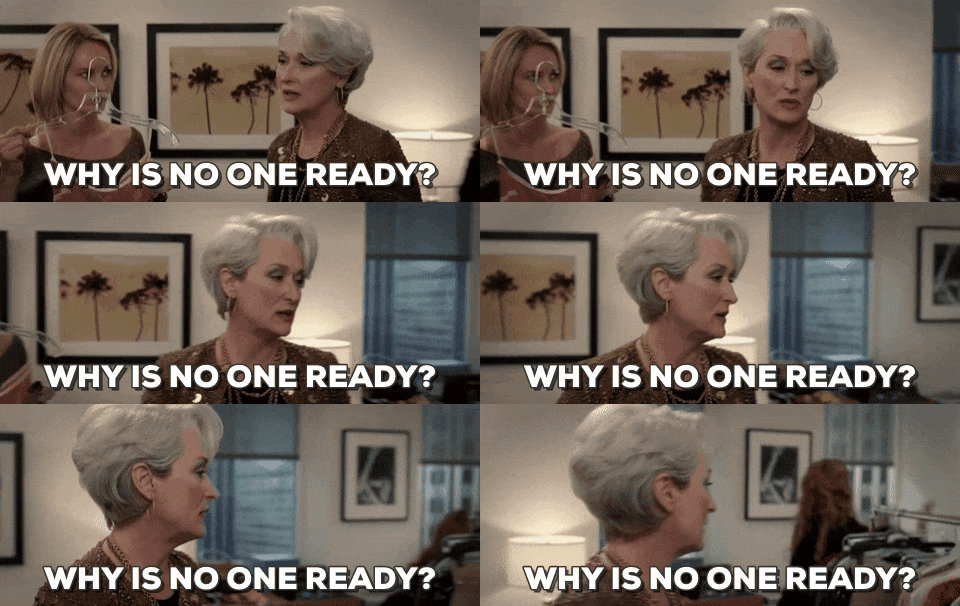
If you've seen The Devil Wears Prada, you probably heard that sentence in Miranda Priestly's voice before you even finished reading it.
I certainly did.
Yesterday morning I scheduled a one-hour onboarding sessionto train people how to use the travel software that I use. Two people joined. Both were on their phones.
They were supposed to spend the hour building an entire sales page for an upcoming event. Instead, within about seven minutes, we discovered they couldn't realistically do any of it. They hadn't logged in ahead of time to make sure their passwords worked. They hadn't watched the short orientation videos I'd sent. They hadn't looked over the workbook. They weren't even using devices capable of following along comfortably.
Seven minutes later, we all politely agreed there wasn't much point in continuing.
As I closed Zoom, I found myself channeling Miranda.
Why is no one ready?
The funny thing is, Monday wasn't much different.
I met my friend Russ for dinner at a neighborhood restaurant we'd both been wanting to try. The hostess seated us quickly, but our server appeared looking slightly panicked, notepad nowhere in sight. She apologized because she'd forgotten to bring silverware. Then she came back to ask what we'd ordered because she'd left her pad somewhere. My whipped feta appetizer arrived without pita chips. For a moment, I wasn't sure if they expected me to scoop up the mess with my fingers. Russ's entrée showed up without the side dish listed on the menu. The manager eventually appeared, apologized sincerely, and made everything right.
The food was actually fine.
The people were genuinely kind.
Nobody was lazy.
But the evening felt like watching a play where every actor knew roughly what scene they were in but nobody had rehearsed together.
Again, I heard Miranda.
Why is no one ready?
Now, before this turns into an editorial about the decline of civilization, I should confess something.
This isn't entirely their fault.
It's mine, too.
I have a habit of assuming other people approach preparation the same way I do.
If I'm attending a training, I've already clicked every link. I've tested my password. I've read the instructions. I've opened three browser tabs I probably won't even need. I have notes. I have questions. I probably have backup questions in case my first questions get answered before I ask them.
That's just how my brain works.
So when someone arrives completely unprepared, it feels almost impossible for me to understand.
But that's the mistake.
Expectation isn't reality.
It's projection.
I'm projecting my own habits onto people whose brains simply don't operate that way.
Miranda Priestly, despite being portrayed as the villain, was actually fascinating in this regard.
She wasn't upset because people made mistakes.
She was upset because she expected excellence, and she surrounded herself with people whose job descriptions included delivering it. She had contingency plans. Backup plans. Backup plans for the backup plans. She assumed that professionals would prepare before they arrived.
That's not cruelty.
That's management.
Where she crossed the line was assuming everyone could—or even wanted to—live at that altitude every waking minute.
I've realized I sometimes do the same thing.
Not because I'm trying to control anyone.
Because I genuinely want people to succeed.
When someone pays for training, I want them to squeeze every ounce of value from it. When a friend asks for advice, I want them to have already thought through the problem. When we schedule an hour together, I want that hour to matter.
But wanting that for someone doesn't automatically mean they want it the same way I do.
That's been an uncomfortable lesson.
Lately I've been experimenting with something new.
Instead of assuming people know what I need, I tell them.
I explain the expectations.
I send an outline.
I give a deadline.
I remind them what to bring.
And then...
I let go.
Because once expectations have been communicated clearly, the next choice belongs to them.
If they come prepared, wonderful.
If they don't, that's information, too.
Maybe the bigger change, though, needs to happen inside me.
I'm considering declaring one day each week an "Expectation-Free Day."
No assuming the restaurant will get everything right.
No assuming emails will be answered.
No assuming meetings will start on time.
No assuming people will prepare the way I would.
Just curiosity.
Just observing the world as it actually is instead of comparing it to the version I've already written in my head.
Who knows?
Maybe life feels lighter when every moment isn't being measured against an invisible checklist.
Miranda Priestly would probably hate that idea.
But I suspect I'd enjoy Tuesdays a whole lot more.