
The Only Gringo at the Table

On the strange fear of being included—and the magic waiting on the other side of yes
It is Saturday night, going on 9:00 p.m., and I have just returned home from a six-hour party here in Mexico.
Six hours.
That is not a party. That is a relationship.
My adorable realtor, Alonso, invited me to celebrate with eight of his closest friends. To say I was flattered does not quite cover it. I was touched. There is something deeply personal about being welcomed into someone’s inner circle, especially when you are still learning the language, the rhythms, and all the unwritten rules of a place that is becoming home.
Most people have FOMO—the fear of missing out.
I have FOBI: the fear of being included.
Missing out is easy. You stay home, put on something comfortable, finish your work, listen to the rain, and tell yourself you will go next time.
Being included is much riskier.
Now you have to show up. You have to walk into a room where everyone may know one another better than they know you. You may not understand every joke. You may say the wrong word, miss a cue, or sit there smiling while your brain is still translating a sentence everyone else finished ten seconds ago.
But this invitation was one I could not turn down.
The party was supposed to begin at 3:00 p.m. I arrived at 2:45, because apparently I brought my American relationship with the clock across the border with me.
Just as I entered the restaurant, the sky opened.
Rain came down in sheets. Lightning flashed across the sky, thunder rolled over the city, and for nearly an hour Mexico put on a show grander than anything the rest of us had planned.
I was the first guest to arrive. Very much the first.
The next person appeared at 3:25. Our guest of honor arrived at 3:40.
Here, time can be a suggestion rather than a deadline. People arrive when they arrive, the table fills when it fills, and the afternoon begins once everyone is ready for it. Nobody was frantic. Nobody apologized as though civilization had collapsed.
We simply settled in.
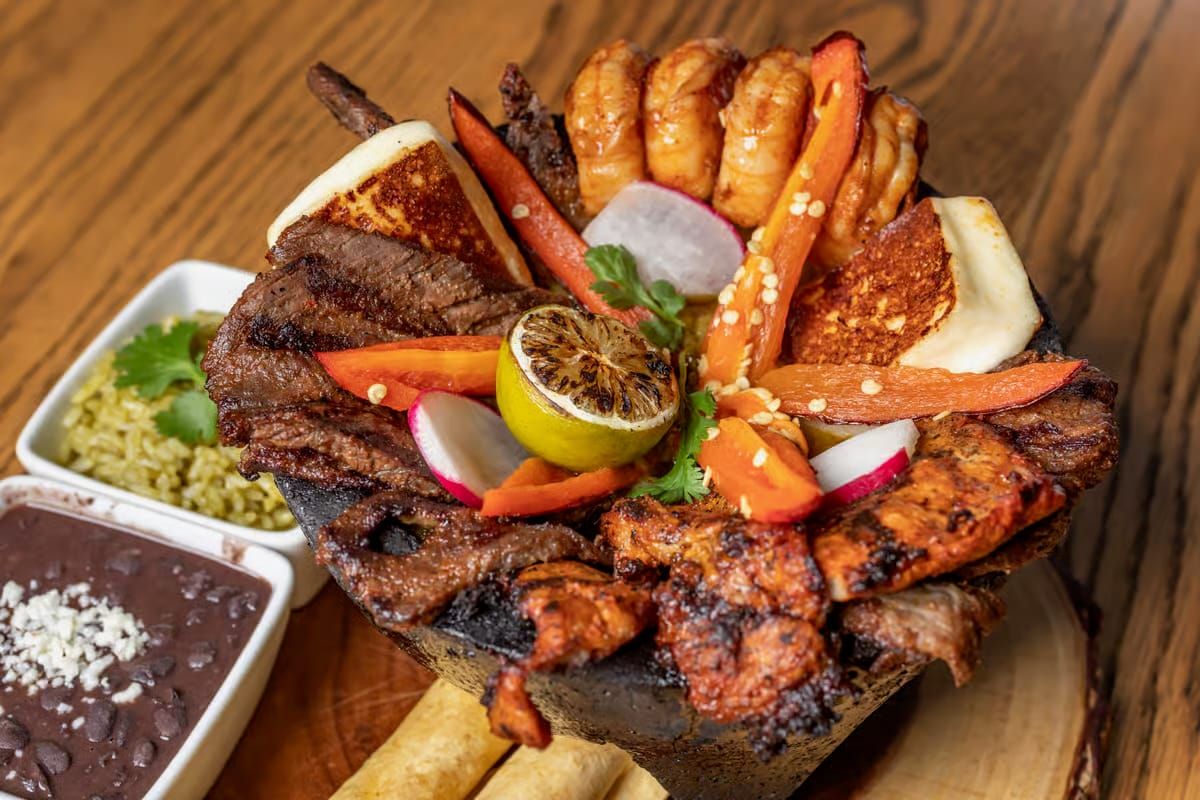
Alonso ordered three salads for the table, and we passed them around family-style. Then came the molcajete, one of my favorite Mexican dishes. It arrived bubbling in a heavy bowl made from volcanic rock, filled with meat, vegetables, cheese, and nopales. You reach in for whatever looks good, tuck it into a warm tortilla, and build one delicious bite after another.
It is not a tidy, private little meal. It asks you to reach across the table.
It asks you to share.
And there I was: the only gringo at the table.
I fought my way through Spanish as best I could. Alonso’s friends answered me in English whenever I struggled. Their English was far better than my Spanish, but I refused to surrender completely. I kept trying. I reached for words I knew, mangled a few verb tenses, listened hard, and trusted that meaning would somehow make it across.
It did.
That is the funny thing about connection. Perfect language helps, but it is not always required. People can tell when you are making an effort. They can feel the difference between someone standing outside the experience and someone trying—awkwardly, imperfectly, sincerely—to step inside it.
After two and a half hours at the restaurant, Alonso invited everyone back to his house for coffee and cake.
If I am honest, part of me wanted to go home. I had a newsletter to finish. The rain was still falling, and my quiet house was calling to me like a lover who knew exactly what I needed.
But how do you say no to a man who has just welcomed you so generously into his life?
So I went.
Alonso recently finished building his home, a beautiful modern four-bedroom house. We settled in, drank coffee, talked some more, and eventually the cake appeared. The afternoon softened into evening without anyone trying to hurry it along.
Six hours after I had first arrived at the restaurant, I finally poured myself into an Uber.
Even the ride home had a little magic tucked inside it.
My driver was a wonderful young man who began speaking Spanish with me. He asked how my Spanish was, and I told him the truth: I understand quite a lot, but my speaking is so-so.
We continued in Spanish. I did my best, reaching for vocabulary and hoping my sentences landed somewhere near their intended destination.
Once he saw that I was really trying, he suddenly switched to perfect English.
It turned out he had lived in Louisiana for several years—and, as he cheerfully explained it, had married a couple of women who helped teach him English.
So we made an agreement without ever stating one: he spoke English to me, and I answered in Spanish whenever I could. Two men moving through the rainy streets of San Miguel, each making room for the other.
By the time I reached home, I felt full in every possible way.
The food was wonderful. The house was beautiful. The storm had been magnificent. But that was not what made the night magical.
The magic was being included—and allowing myself to stay included.
Community is a word we use so often that we can forget what it asks of us. We think community is something we find, as though the right group of people is sitting somewhere waiting for us to walk in and feel instantly at home.
Sometimes that happens.
More often, community asks us to be uncomfortable first.
It asks us to accept the invitation when staying home would be easier. It asks us to sit at a table where we are the outsider. It asks us to speak badly, listen carefully, misunderstand things, laugh anyway, and trust that our awkwardness will not kill us.
It asks us to be vulnerable enough to let people see that we want to belong.
That may be the hardest part. Wanting friendship can feel strangely exposing. Admitting that we need people can feel even more so. Many of us have become very good at being independent, productive, busy, and unavailable.
We protect ourselves from rejection by never giving anyone the chance to choose us.
Then someone like Alonso opens a seat at his table.
The brave thing is not arriving with flawless Spanish, perfect confidence, or a sparkling story for every lull in the conversation.
The brave thing is simply taking the seat.
That table reminded me that belonging is not always built through grand declarations. Sometimes it grows through a shared salad. A tortilla passed from one hand to another. A badly conjugated verb. A second cup of coffee. Staying for the cake when you had planned to leave hours ago.
We spend so much of our lives waiting to feel ready. Ready to speak the language. Ready to make friends. Ready to enter the room without worrying whether we fit.
But perhaps readiness is overrated.
Perhaps the life we want begins when we walk in fifteen minutes early, sit alone while the rain pounds against the windows, and wait for the table to fill.
Eventually, it does.
And if we are lucky, someone passes us a tortilla.